Architecture and results
This page presents the final architecture developed within the project, along with the main results obtained, drawn from the doctoral research conducted by Marine Capallera, Emmanuel de Salis and Quentin Meteier (PhD theses, University of Fribourg / HES-SO) and their related publications.
Final architecture: the AdVitam system
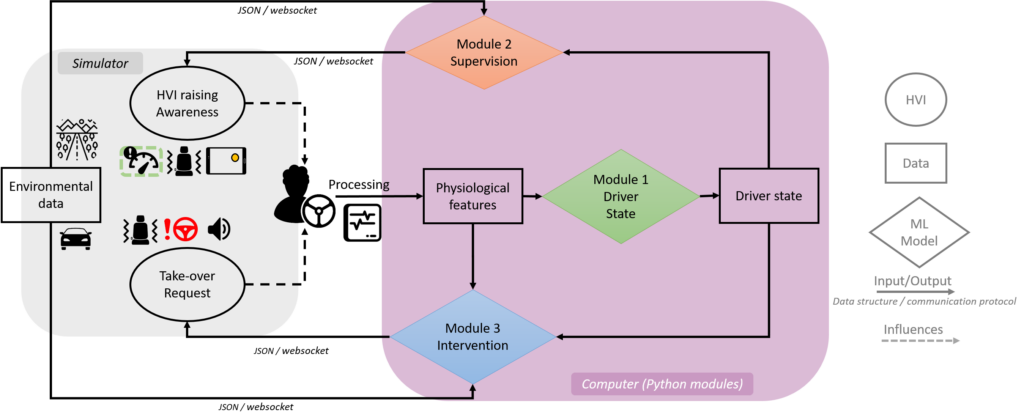
The project resulted in AdVitam (Advanced Driver-Vehicle Interaction to Make future driving safer), a system designed to support the driver during conditionally automated driving phases (SAE level 3). The architecture is organized around three interconnected modules:
1. Driver State module
Developed primarily as part of Quentin Meteier’s thesis, this module estimates the driver’s physiological state in real time from several signals: electrodermal activity (EDA), heart activity (ECG), and respiration. These signals are processed and converted into features, used to train machine learning models assessing four dimensions of the driver’s state: fatigue, stress, cognitive load, and situation awareness.
2. Supervision module
Coming from Marine Capallera’s work, this module conveys information about the environment to the driver during delegated driving phases, in order to maintain their situation awareness. It combines several interaction channels:
- a haptic seat (vibrotactile feedback);
- a personal device (tablet);
- ambient lighting in the cabin.
3. Intervention module
This module selects, at the moment of takeover, the most appropriate combination of modalities (haptic, auditory, visual) to prompt the driver, with the goal of optimizing the quality and speed of the vehicle takeover.
Main results
Driver state classification
Models built from physiological signals (EDA, ECG, respiration) achieved good accuracy in classifying drivers’ mental workload, with a Random Forest–based model reaching approximately 95% accuracy under certain experimental conditions. This work showed that different physiological signals vary measurably depending on the type of secondary task performed by the driver (auditory, oral, visual), confirming their relevance as indicators of mental state during automated driving.
Supervision interfaces
Research comparing different human-vehicle interaction concepts (haptic seat, tablet, ambient light) helped identify the most effective combinations for conveying useful information without overloading the driver during automated phases.
Takeover quality prediction
The machine learning model developed for the Intervention module achieved a 42.26% gain in reaction time and an 8.92% gain in maximum steering wheel angle compared to a baseline, when predicting these two takeover quality metrics from pre-takeover psychophysiological data. A complementary study explored unsupervised clustering of drivers’ physiological states before takeover situations; most of the resulting clusters were not statistically significant, suggesting that supervised approaches using ground-truth labels are better suited to this kind of classification task.
Evaluation of the complete AdVitam system (IEEE Access, 2023)
A study was conducted with 35 drivers on a fixed-base driving simulator, across two environments (rural and urban). The activation of the Supervision and Intervention modules was manipulated as two independent experimental factors. The results show that:
- conveying contextual information through multimodal interfaces improves drivers’ situation awareness (better detection of potential risks in the environment);
- it increases drivers’ trust in the automated system.
An open dataset (ScienceDirect, 2023)
The project also produced a reference dataset, gathering data from 346 drivers across six experiments (five in level-3 automated driving, one in manual driving). It combines physiological signals, driving behavioral data, and questionnaire responses, and serves as an open resource for the affective computing and human factors in transportation research community.